
The Triangle of Youth vs the Pyramid of Ageing: How Our Faces Change Over Time
What facial shape can tell us about ageing, volume loss and the role of dermal filler.
Have you ever looked at an old photo of yourself and thought, something about my face looks different, but I can't quite put my finger on what it is?
Maybe your cheeks don't look quite as full. Perhaps your jawline seems a little softer, or your face looks less defined than it used to.
It's not always about wrinkles. As we age, the underlying structure and soft tissues of our faces change too, affecting the way light falls across our features and how our facial contours look.
One way aesthetic practitioners describe some of these changes is through the Triangle of Youth and the Pyramid of Ageing.
It sounds a little technical, but the idea is actually quite simple. Let me explain.
What is the Triangle of Youth?
Picture an upside-down triangle.
The broadest part sits across the cheeks and midface, with the shape narrowing towards the chin.
This is the traditional aesthetic concept known as the Triangle of Youth. It's often used to describe facial proportions associated with youthfulness: fuller-looking cheeks, definition through the midface and a more tapered lower face.
Of course, faces come in all shapes and sizes. This isn't a rule that everyone needs to follow, and a beautiful face certainly doesn't have to fit a particular geometric shape.
It's simply a useful way of understanding some of the changes that can happen to our facial contours over time.
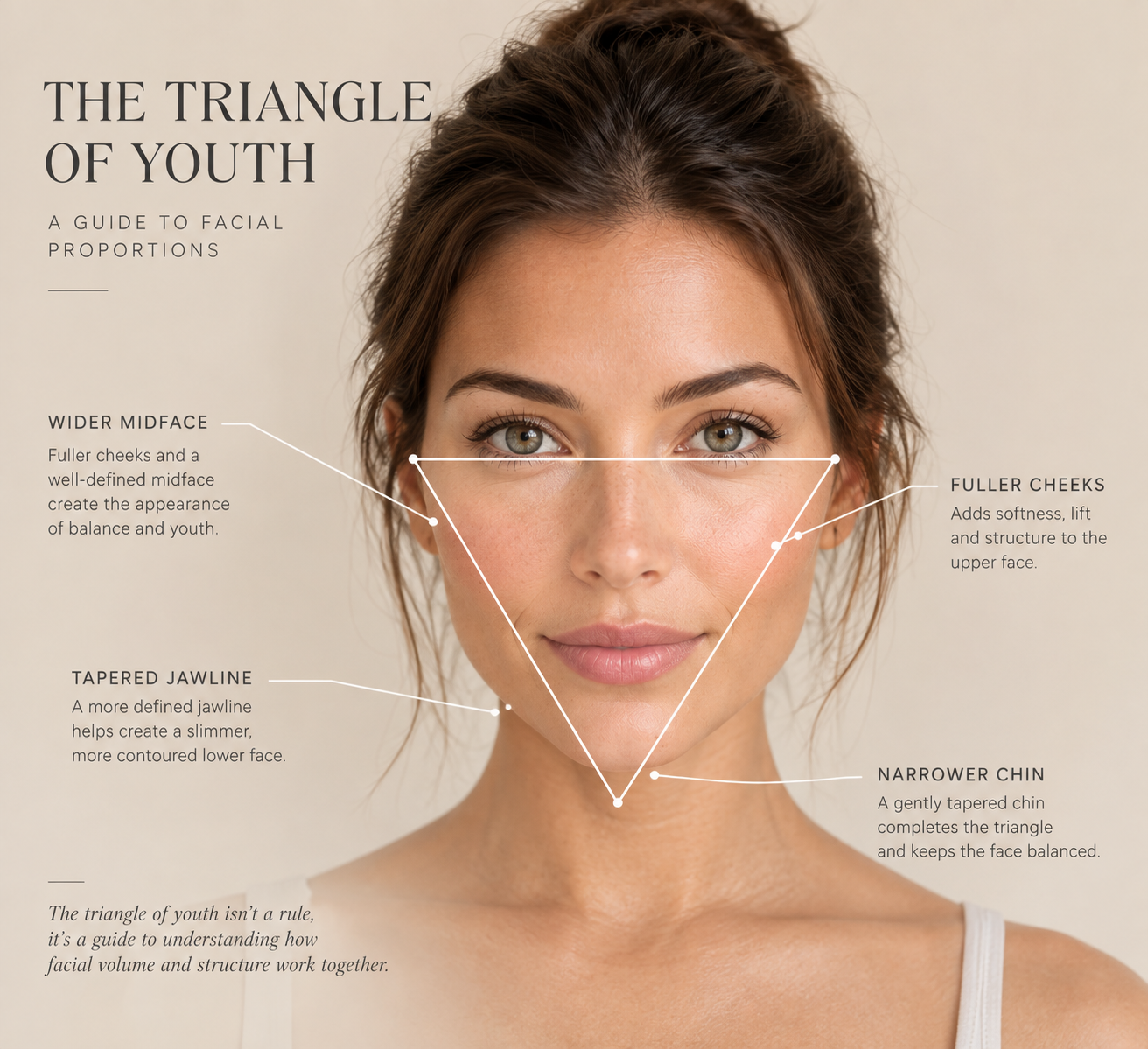
Diagram of the Triangle of Youth
What happens as we age?
As we get older, several changes can happen beneath the skin as well as at its surface.
We can lose volume in certain areas of the face. Fat compartments can change in size or position, the skin gradually loses some of its elasticity, and changes in the underlying bone structure can also affect facial support.
Gravity plays a part too.
Together, these changes can alter the relationship between the cheeks, midface and lower face. The cheeks may look less full, the jawline may appear softer, and the lower face can seem broader in relation to the midface.
This is where the Pyramid of Ageing comes in: the inverted triangle becomes more like an upright triangle, with a broader lower face and less apparent fullness through the midface.
It's a simplified illustration rather than a description of everyone's ageing process. The changes vary from person to person, and not every face follows this pattern.
But it helps explain why facial ageing can be about more than the appearance of individual lines.
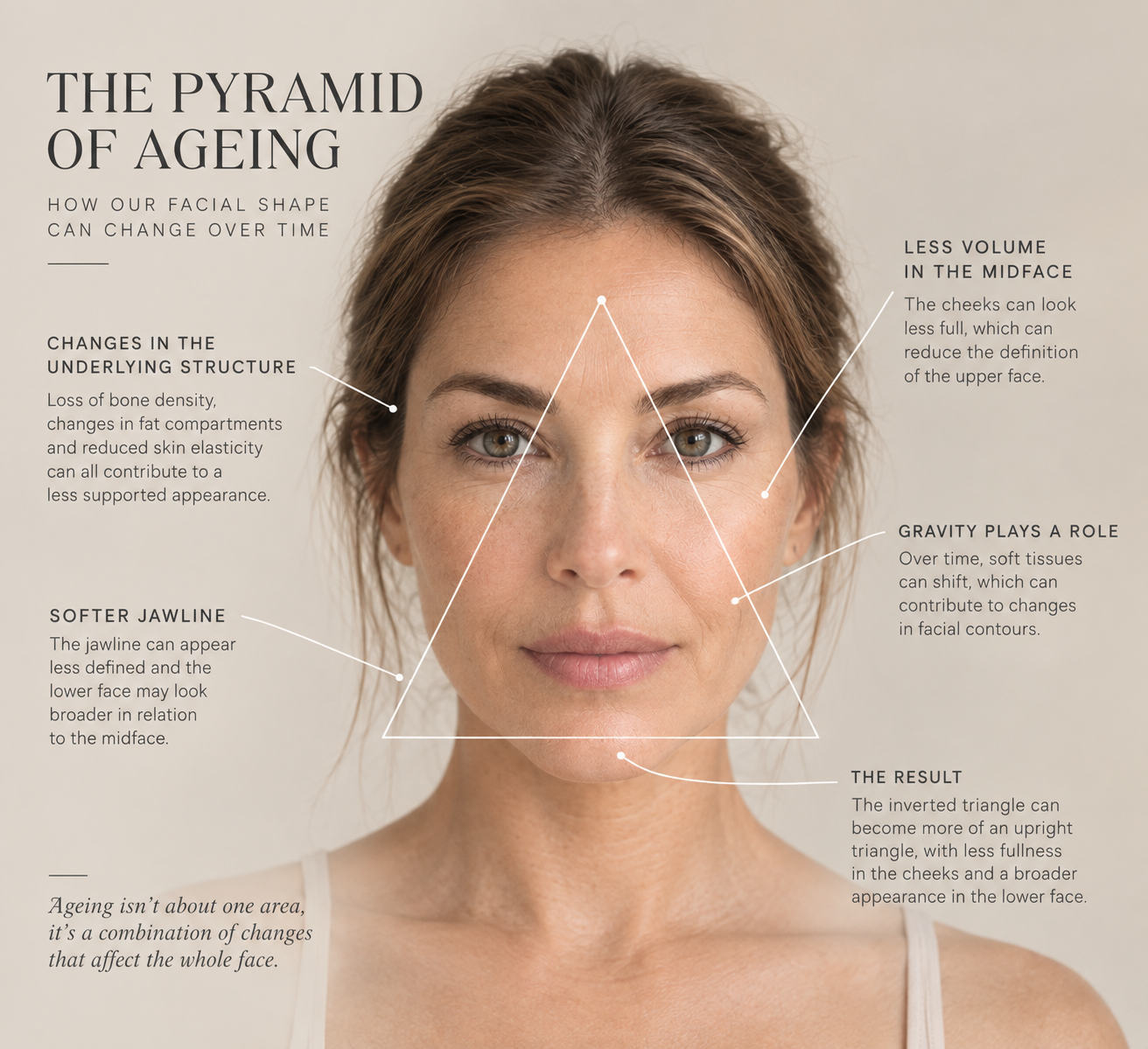
Diagram of the Pyramid of Ageing
Is it all about losing volume?
Not quite.
Volume loss is one part of facial ageing, but it's not the whole story.
Changes in skin quality, elasticity, bone structure and the position of soft tissues can all influence how our faces look over time.
That's why treating every concern with filler isn't necessarily the answer.
If your main concern is skin texture, fine lines or uneven tone, a treatment aimed at improving skin quality may be more appropriate. If you're concerned about changes in facial volume or definition, filler may be worth discussing.
The important thing is understanding what's actually contributing to the change you're noticing, rather than assuming every sign of ageing needs the same treatment.
Can dermal filler restore the Triangle of Youth?
Dermal filler can be used to restore selected areas of lost volume, enhance certain features or provide support and definition in appropriate areas of the face.
For some people, carefully placed filler in areas such as the cheeks may help address changes in volume and facial contour.
But I wouldn't approach it as trying to recreate an upside-down triangle at all costs.
Your face isn't a template, and the aim shouldn't be to make everyone look the same.
Adding volume without considering the surrounding features can leave the face looking out of balance. More filler doesn't automatically mean more definition, and treating one area in isolation may not give you the result you're hoping for.
A good treatment plan considers your existing facial structure, skin quality, previous treatments and personal goals. It also takes into account what filler can realistically achieve — and what it can't.
Sometimes a small, considered change can make a difference. Sometimes a different treatment is more suitable. And sometimes there's no need to treat the area at all.
Why facial balance matters more than chasing a shape
I think this is the most important part of the conversation.
It's easy to see diagrams of the Triangle of Youth online and start looking for ways to make your own face fit that shape.
But these diagrams are teaching tools, not beauty standards.
You don't need prominent cheekbones, a particularly narrow chin or a perfectly defined jawline to look good. Your natural features are what make your face yours.
When I assess someone for filler, I'm interested in what they've noticed, what they'd like to improve and how their features work together.
Perhaps they've lost some fullness in their cheeks. Perhaps they'd like a little more definition. Or perhaps what they're noticing has more to do with skin quality than volume.
Those are very different concerns, and they deserve individual consideration.
The aim is to find an approach that suits the person sitting in front of me, rather than trying to make their face fit a trend.
Could filler be right for you?
If you're noticing changes in your facial contours and wondering whether dermal filler might help, the best place to start is with a consultation.
At GLO Aesthetics in Rustington, we'll talk through what you've noticed, assess your features and discuss the options that may be suitable for you.
I'll explain what filler can realistically achieve, as well as its limitations and risks. If another treatment is more appropriate, we'll discuss that too.
There's no need to arrive knowing exactly what you want or which area you think needs treating.
That's what the consultation is for.
Ageing doesn't mean your face needs fixing. But if you'd like to understand the changes you're noticing and explore your options, I'm here to help you make an informed decision.
Get in touch with GLO Aesthetics to arrange a consultation.
Bianca x